
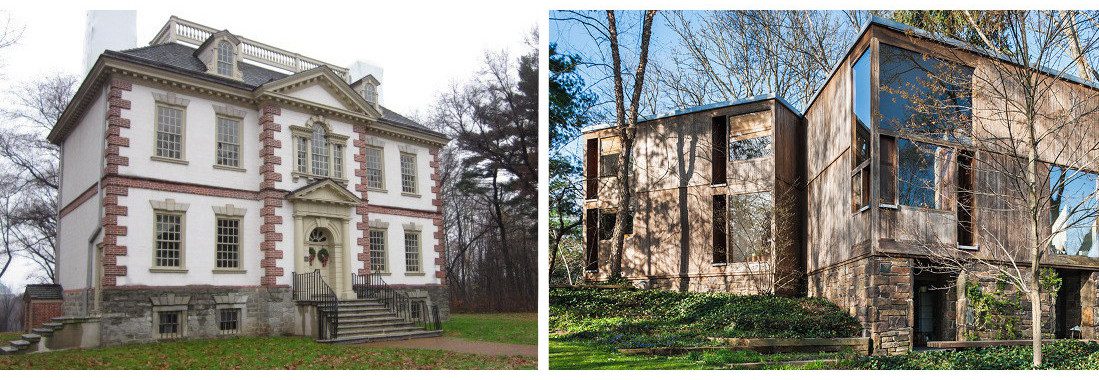
As a student at the University of Pennsylvania, I became increasingly interested in a recurring theme within Philadelphia architecture: the ability of local materials to mediate between regional building traditions and broader international architectural ideas. Across dramatically different architectural periods, many of the region’s most enduring buildings share a common sensibility—an emphasis on material continuity between architecture and landscape.
Two residential projects that exemplify this relationship are Mount Pleasant in Fairmount Park, Philadelphia (c. 1761), designed by Thomas Nevell for John Macpherson, and the Fischer House in Hatboro, Pennsylvania (1967), designed by Louis Kahn. Although separated by more than two centuries and conceived within entirely different architectural movements, both houses demonstrate how regional materials can ground architecture within its physical setting while still expressing the intellectual and cultural ideals of their time.
Mount Pleasant reflects the symmetry, order, and proportion associated with Georgian architecture, while Kahn’s Fischer House embodies the spatial clarity and abstract geometry of twentieth-century modernism. Yet despite their formal differences, both projects rely heavily on rough local stone to establish a visual and material connection to the Pennsylvania landscape.
In each case, the stone extends the architecture outward, allowing the buildings to feel anchored to the earth rather than placed upon it. The texture, color variation, and mass of the material soften the boundary between natural and constructed environments, creating a continuity that gives both houses a sense of permanence and belonging.
Louis Kahn, in particular, understood material as more than surface treatment. In many of his residential projects, materials were used to reinforce weight, shadow, light, and spatial calm. The Fischer House demonstrates how modern architecture can remain deeply connected to local context without resorting to historical imitation. Its use of stone allows the house to participate in the regional architectural language of Pennsylvania while remaining unmistakably modern.
This relationship between contemporary design and regional materiality remains highly relevant in residential architecture today. Homes that respond thoughtfully to local climate, landscape, and building traditions often feel more enduring and emotionally grounded than architecture driven solely by stylistic trends.
By combining broader architectural ideas with materials rooted in place, both Thomas Nevell and Louis Kahn demonstrate how architecture can feel simultaneously timeless, contemporary, and inseparable from its environment.